A Complete Guide to Traditional Indian Jewelry & Adornments
Long before diamonds were cut or gold was minted into coins, the people of the Indus Valley were stringing beads of carnelian, shell, and terracotta into ornaments meant to adorn the body and mark identity, status, and belief. Over five thousand years later, that same impulse still runs through every wedding, festival, and celebration across the subcontinent. Traditional Indian jewelry is not a single style but an extraordinary, living tapestry of regional techniques, sacred symbolism, and craftsmanship passed down through generations — from the filigree of Odisha to the temple gold of Tamil Nadu to the Kundan work of Rajasthan.
In this guide, you'll learn where these traditions came from, how they differ from region to region, what each piece is called and worn for, the metals and gemstones that define them, and the deep cultural and religious meaning woven into nearly every ornament an Indian woman wears.
A Brief History of Indian Jewelry Traditions
The history of Indian jewelry stretches back further than almost any other continuous ornamental tradition in the world, and tracing it offers a genuine window into how craftsmanship, trade, and belief have shaped adornment across the subcontinent.
Indus Valley origins
The earliest verified evidence of jewelry-making in the region comes from the Indus Valley Civilization, dating back over 5,000 years. Archaeological excavations at sites like Mohenjo-daro and Harappa have uncovered ancient Indian ornaments made from terracotta, shell, and carnelian beads, along with early metalwork in gold and copper. These pieces, simple by later standards, already show a clear interest in symmetry, pattern, and personal adornment as a marker of identity.
Vedic and ancient periods
As Vedic culture developed, gold took on a distinctly sacred role, associated with purity, the sun, and divine energy. Jewelry became tied to ritual and religious life in ways that persist today, and the earliest concepts of temple jewelry, ornaments crafted specifically for deities and later adapted for human wear, began to take shape during this period.
Mughal influence
Few periods shaped Indian jewelry as dramatically as the Mughal era. Mughal jewelry introduced and refined techniques like Kundan (setting gemstones in gold foil), Polki (uncut, natural diamonds set in gold), and Meenakari (vibrant enamel work), blending Persian aesthetics with Indian craftsmanship. Many of the most recognizable bridal jewelry styles worn across India today trace their techniques directly back to Mughal royal workshops.
Colonial era and beyond
The colonial period introduced new influences, including European cutting and setting techniques, which began to appear alongside traditional Indian styles. This era also saw the beginnings of revival movements, as artisans and patrons worked to preserve traditional techniques that risked being overshadowed by imported styles and mass production.
Modern day
Today, traditional Indian jewelry enjoys genuine global appreciation, with designers reinterpreting centuries-old techniques for contemporary tastes while artisans in regions like Rajasthan, Odisha, and Tamil Nadu continue to practice traditional methods passed down through generations. The result is a living tradition — not a museum piece, but jewelry that's worn, adapted, and celebrated every single day.
Regional Styles of Traditional Indian Jewelry
India's sheer geographic and cultural diversity means jewelry traditions vary enormously from region to region, each shaped by local materials, religious practices, and centuries of distinct craftsmanship.
North India
North Indian jewelry, particularly from Rajasthan and Uttar Pradesh, is closely associated with some of the most recognizable techniques in Indian jewelry as a whole. Kundan jewelry, which involves setting gemstones or glass into gold foil, remains one of the most sought-after bridal styles nationwide. Polki, the uncut-diamond counterpart to Kundan, and Meenakari, the colorful enamel work often found on the reverse side of Kundan pieces, are hallmarks of Rajasthani jewelry specifically. Thewa work, a specialized technique combining intricately cut gold with colored glass, is another North Indian art form, historically associated with the town of Pratapgarh in Rajasthan.
South India
South Indian jewelry takes a markedly different approach, favoring dense, gold-heavy designs with deep religious and temple associations. Temple jewelry India refers to ornate gold pieces originally crafted for adorning temple deities, later adapted into bridal and classical dance jewelry across Kerala and Tamil Nadu. This style is characterized by intricate filigree work, deity motifs, and a preference for pure, high-karat gold over gemstone-heavy designs. Kondapalli, a form of wooden and gilded ornamentation from Andhra Pradesh, is another regional craft associated with the broader South Indian tradition of intricate, labor-intensive handwork.
East India
Eastern India's jewelry traditions lean heavily on tribal and material-driven craftsmanship. Dokra, a form of tribal metal casting practiced in West Bengal and Odisha, uses an ancient lost-wax casting technique to create rustic brass jewelry with a distinctive folk aesthetic. Conch shell jewelry, or shankha, holds deep religious significance in Bengali culture, particularly for married women. Odisha is also home to a renowned tradition of silver filigree work, prized for its delicate, lace-like detailing achieved entirely by hand.
West India
West Indian jewelry, especially from Gujarat, reflects the region's strong tribal and folk craft heritage. Tribal silver jewelry remains a defining feature of Gujarati adornment, often heavily engraved and worn in layered sets. Pachchikam, a mirror and stone-inlay technique, and lac jewelry — bangles and ornaments crafted from a natural resin, often coated in gold leaf or gemstones — are both distinctly regional crafts associated with Gujarat and neighboring areas.
Northeast India
The Northeast's jewelry traditions stand apart from the rest of the subcontinent, shaped by distinct tribal cultures and natural materials. Beaded jewelry, often made from glass, stone, or seed beads, and bamboo jewelry, crafted from the region's abundant natural bamboo, reflect a design sensibility rooted in nature and tribal identity rather than the gold-and-gemstone traditions more common elsewhere in India. Each tribal community across states like Nagaland, Manipur, and Meghalaya maintains its own tribal jewelry India styles, often tied closely to specific rituals and social status.
Types of Traditional Indian Jewelry by Body Placement
Traditional Indian jewelry is remarkably comprehensive, with distinct ornament categories for nearly every part of the body — a tradition rooted in the idea that adornment is a complete, head-to-toe practice rather than a scattering of accessories.
Head and Hair
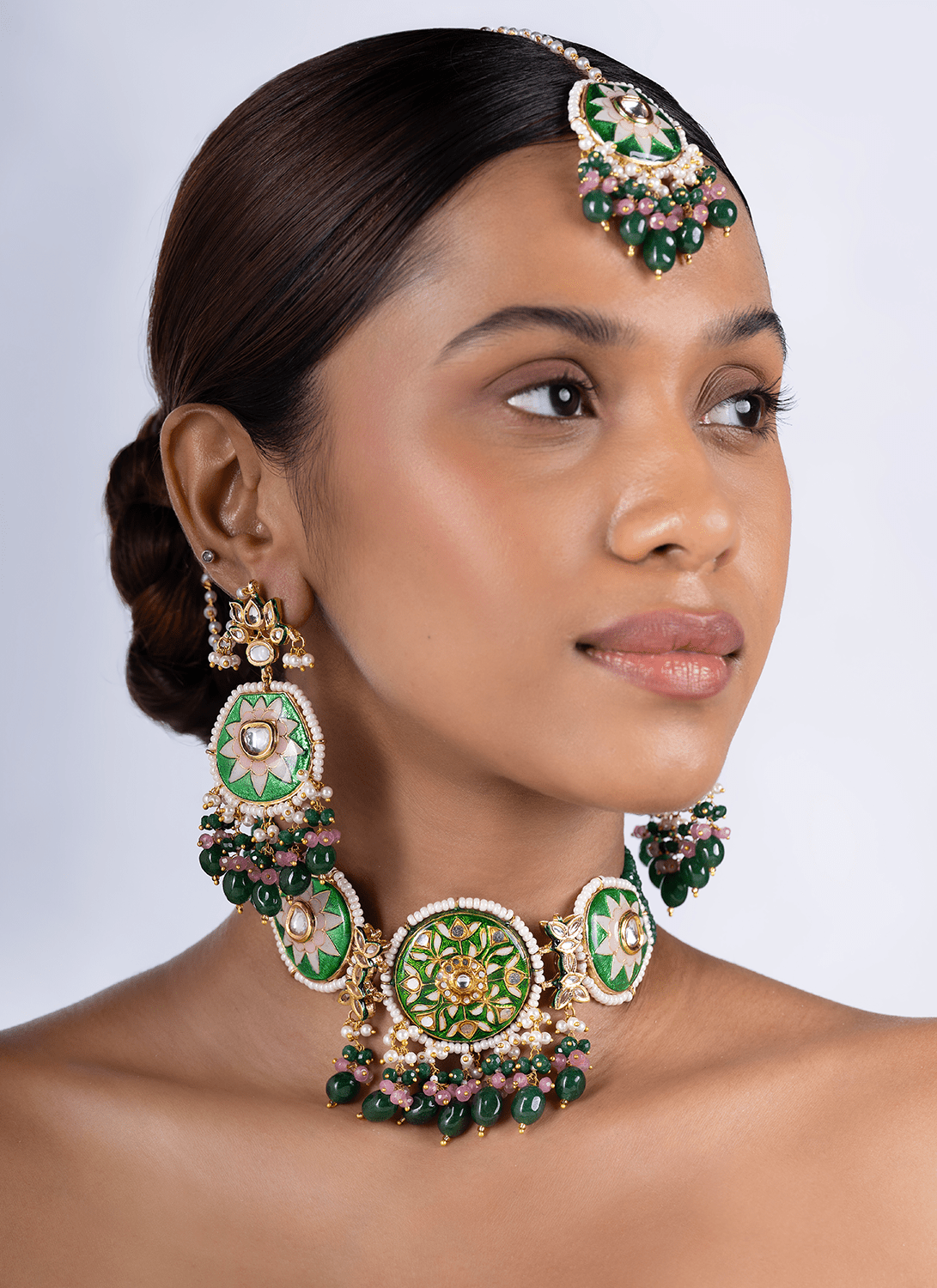
The Maang tikka, a pendant worn at the center part of the hair, is among the most iconic bridal pieces in Indian jewelry. Jhoomar, worn along the side of the head, Passa, and Matha Patti — an ornamental headpiece that frames the forehead — round out this category, most commonly worn for weddings and major celebrations.
Ears
Earrings encompass some of the most varied pieces in Indian jewelry. Jhumka earrings, bell-shaped drops with roots in traditional craftsmanship, remain one of the most enduringly popular styles. Kaan chains, which connect the earring to the hair for added support and drama, Bahubali-style earrings inspired by South Indian temple aesthetics, and simple Bali hoops all serve different occasions, from everyday wear to full bridal looks.
Nose
The Nath, Nathni, and Mookuthi (a South Indian nose stud) carry significant cultural and bridal meaning across Indian communities, often symbolizing marital status or serving as an essential part of bridal dress in specific regional traditions.
Neck
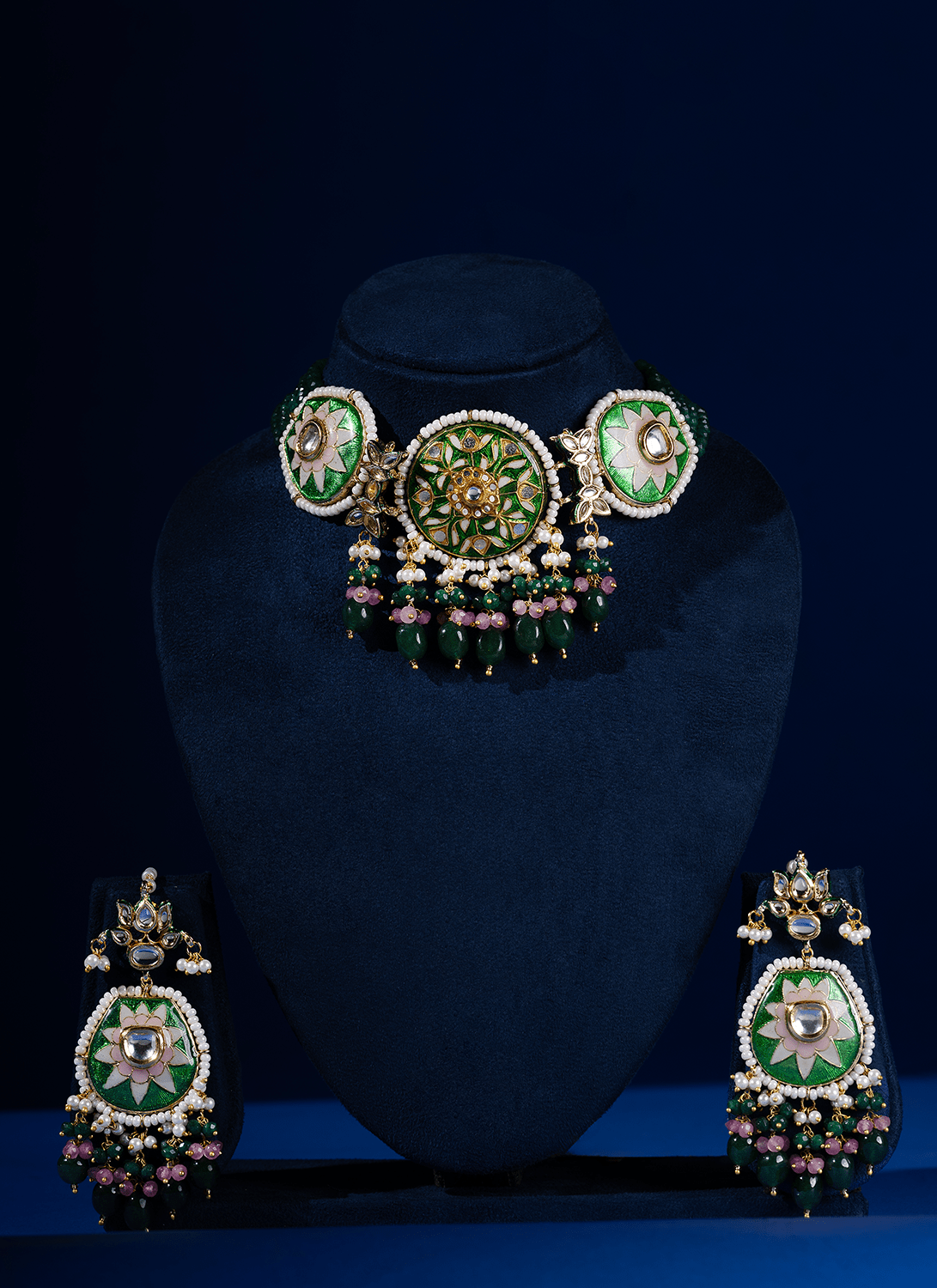
Neck jewelry offers perhaps the widest variety of any category. The Mangalsutra, worn by married Hindu women, sits at the more symbolically significant end of the spectrum, while Haar (a general term for necklace), Rani Haar (a long, elaborate necklace historically associated with royalty), Thushi (a close-fitting beaded necklace from Maharashtra), and Hasli (a rigid collar-style necklace) each serve distinct aesthetic and cultural purposes. Pieces like our Gold and Moissanite Mala Necklace Set for a distinctive neckpiece that also comes with a matching set of earrings and maang tikka.
Wrists and arms
Indian bangles, worn in stacks and various metals, are among the most universally recognized pieces of Indian jewelry. Kada, a thick, often rigid bangle, Panchla, and Vanki, an upper-arm band traditionally worn by South Indian brides, complete this category.
Waist
Kamarbandh or Arinjanam or Ottiyanam is a decorative waist belt, holds both bridal and classical dance significance, historically worn to cinch and accentuate the waist during ceremonies and Bharatanatyam or Odissi performances.
Feet and toes.
Payal anklet or Kolusu styles, along with Bichiya toe rings, carry ritual meaning beyond pure decoration — toe rings in particular are traditionally worn by married Hindu women and are believed to carry both symbolic and, in some traditions, health-related significance.
Materials, Metals & Gemstones Used in Indian Jewelry
The materials behind traditional Indian jewelry are just as storied as the designs themselves, each carrying its own cultural weight and regional association.
Gold holds unmatched cultural and economic significance across India, viewed not just as an adornment but as a form of investment and financial security, particularly for women. Indian jewelry typically uses 22kt gold for its rich color and malleability, in contrast to the 24kt gold used for pure bullion, and hallmarking, an official purity certification, has become an increasingly important standard for buyers across the country.
Silver carries strong tribal and regional associations, particularly in Gujarat, Rajasthan, and the Northeast, and the oxidized silver trend, silver deliberately darkened for an antique, textured finish, has become especially popular in contemporary fashion jewelry.
Precious gemstones, including rubies, emeralds, sapphires, and diamonds, feature prominently in bridal and formal Indian jewelry. Polki, uncut natural diamonds retained in their raw form rather than faceted, remain especially prized for their traditional, slightly imperfect brilliance.
Semi-precious and traditional stones like carnelian, coral, turquoise, and pearl have been used in Indian jewelry since antiquity, often carrying their own symbolic or astrological associations in addition to their decorative value.
Other materials, including lac, shell, glass beads, terracotta, and brass (as seen in Dokra work), reflect the more accessible, folk side of Indian jewelry-making, prized for craftsmanship and cultural authenticity rather than precious material value.
Enamel work, or Meenakari, involves fusing colored glass powders onto metal to create vivid, detailed designs, traditionally found on the reverse side of Kundan and Polki jewelry. Rajasthan, particularly the city of Jaipur, remains the most renowned center of Meenakari production in India. Our collection of extensive jewellery also features beautiful Meenakari pieces like the Green and Pink Meenakari Choker Set, Light Green and Ruby Meenakari Necklace Set and more to choose from.

Cultural & Religious Significance of Indian Adornments
Traditional Indian jewelry is rarely just decorative as most pieces carry religious, social, or symbolic meaning that shapes when, how, and by whom they're worn.
Jewelry in Hindu tradition is deeply connected to the concept of Solah Shringar, the sixteen traditional adornments of a Hindu bride, which include everything from jewelry and mehndi to specific hairstyles and cosmetics. Solah Shringar represents a complete, ritualized approach to bridal beauty, with each element believed to enhance auspiciousness and invoke blessings for the marriage.
Bridal jewelry typically includes specific key pieces like the maang tikka, nath, mangalsutra, and a full set of bangles among them, each carrying its own symbolic meaning tied to marital status, fertility, or protection. Indian bridal jewelry collections are often the most elaborate a woman will wear in her lifetime, reflecting both celebration and cultural continuity.
Temple jewelry extends beyond religious ritual into performance, particularly in classical dance forms like Bharatanatyam, where elaborate gold jewelry is considered an essential part of the traditional costume, believed to enhance the dancer's connection to the divine stories being portrayed.
Auspicious and protective symbolism runs throughout Indian jewelry traditions. Evil eye charms are worn across many communities to ward off negative energy, while the meaning of Mangalsutra centers on marital protection and commitment, traditionally tied by the groom during the wedding ceremony. Toe rings worn by married women carry similar symbolic weight, marking marital status within many Hindu communities.
Muslim and other community traditions add further richness to India's jewelry landscape, with distinct styles, motifs, and customs shaped by different religious and regional communities across the country. This diversity is part of what makes Indian jewelry, as a whole, so difficult to define through any single style or tradition.
Frequently Asked Questions
What is the most famous type of Indian jewelry? Kundan jewelry is widely considered one of the most iconic and recognizable styles of Indian jewelry, prized for its intricate gold-foil gemstone setting and its central role in North Indian bridal wear. Discover sets like our Mint Green Kundan Medallion Set that pair beautifully with all types of Indian occasionwear.

What jewelry do Indian brides wear? Indian bridal jewelry typically includes a maang tikka, nath (nose ring), mangalsutra, layered necklaces, bangles, and often a kamarbandh, though the exact pieces and styles vary significantly by region and community.
What is Kundan jewelry? Kundan jewelry is a traditional technique of setting gemstones or glass into gold foil, originating in royal Rajasthani workshops and closely associated with Mughal-era craftsmanship. Head over to our jewelry section to explore a wide range of Kunan sets to choose for your next event.
What does Indian jewelry symbolize? Indian jewelry carries meanings ranging from marital status and protection to wealth, religious devotion, and social identity, with different pieces symbolizing different aspects of a wearer's life and beliefs.
How is South Indian jewelry different from North Indian jewelry? South Indian jewelry tends to be gold-heavy with intricate filigree and strong temple associations, while North Indian jewelry often features gemstone-focused techniques like Kundan, Polki, and Meenakari enamel work.
Is Indian jewelry real gold? Traditional Indian jewelry is often crafted in 22kt gold, though fashion and imitation jewelry using gold-plated base metals is also widely available and popular for everyday and festive wear.
The Living Tradition of Indian Jewelry
From carnelian beads strung by Indus Valley artisans to the Kundan and Polki pieces gracing brides today, the story of Indian jewelry is one of remarkable continuity and equally remarkable diversity, a tradition shaped by region, religion, material, and centuries of evolving craftsmanship, yet still recognizably, unmistakably itself. Traditional Indian jewelry isn't a relic of the past; it's a living practice, reinterpreted by each generation while still carrying the weight and meaning of the one before it.
Explore Lashkaraa's jewelry collection to find necklaces, maang tikkas, earrings, and bridal sets crafted in the spirit of the traditions you've just read about.